 An official website of the United States government


Publicizing the outcomes of NIH-funded projects and communicating the role of NIH support in biomedical research improves public understanding of how we, the biomedical research community as a whole, are working to improve human health.
This important information for researchers and public information officers (PIOs) describes how to correctly acknowledge NIH in your presentations, papers, posters, and press releases.
Requirements for Acknowledging NIH-Supported Research
Recipients must acknowledge Federal funding in the following products when describing projects or programs funded in whole or in part with NIH funds:
- research publications
- press releases and other public statements
- other publications or documents about research that is funded by NIH
- requests for proposals and bid invitations
- and other documents describing projects or programs funded in whole or in part with Federal money
These products must include:
- An acknowledgment of NIH grant support clearly stating the percentage and dollar amount of the total costs of the program or project funded with federal money, and the percentage and dollar amount of the total costs of the project or program funded by non-governmental sources.
For example:
“Research reported in this [publication, release] was supported by [name of the Institute, Center, or other funding component] of the National Institutes of Health under grant number [specific NIH grant number in this format: R01GM012345]." A total of $[amount], or [percentage] percent of [research/project/program] [is/was] financed with federal funds. A total of $[amount], or [percentage] percent of [research/project/program] [is/was] financed with non-governmental funds (if applicable)."
- A disclaimer that says:
"The content is solely the responsibility of the authors and does not necessarily represent the official views of the National Institutes of Health."
NIH communicates this requirement to its recipients in the NIH notice of award (NoA), and the NIH Grants Policy Statement (Sections 4.2.1 and 8.2.1).
NIH also expects investigators who generate HeLa cell data or who have been approved for access to such data to acknowledge Mrs. Henrietta Lacks and her family in any publications, presentations, or other public reporting of research using this sample language (or something similar):
- “The genome sequence described/used in this research was derived from a HeLa cell line. Mrs. Henrietta Lacks, and the HeLa cell line that was established from her tumor cells without her knowledge or consent in 1951, have made significant contributions to scientific progress and advances in human health. We are grateful to Mrs. Henrietta Lacks, now deceased, and to her surviving family members for their contributions to biomedical research.”
When to Acknowledge NIH Funding
- Directly arise from the award, and
- Are within the scope of the award being acknowledged
When considering whether acknowledgement is necessary, ask yourself:
- Did the personnel activity supported by the award contribute to the publication?
- Did the award support the conduct of experiments or the analysis of data that contributed to the publication?
- Is there a clear and apparent link between the work described in the publication with the aims and objectives of the grant?
If the answer is yes to any of these questions, cite the appropriate NIH support.
Avoid Over-citing Awards
Understanding when not to cite awards can be just as important as knowing when to cite them. Attributing publications to NIH awards that did not actually support the described work does not align with NIH policy and could inadvertently result in compliance actions.
When not to cite an award
- Unrelated institutional funds: Do not cite general NIH institutional grants (e.g., unrelated training grants) unless direct services, trainees, or core facilities contributed to the project.
- Non-contributing personnel: An investigator listed on an NIH grant does not automatically cite that grant on every published paper; only cite awards where the funding directly supported the specific data, experiments, or salary dedicated to the paper.
- Expired awards without continuity: Do not cite past awards if the work presented was conceptualized and funded under an entirely separate, subsequent mechanism.
Proper Grant Number Format
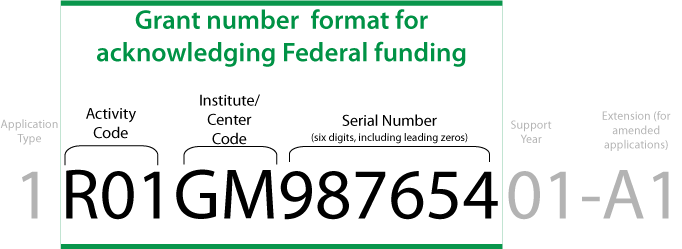
When citing an NIH award, provide only the Activity Code, IC Code, and Serial Number (without spaces or hyphens).
Automated systems (such as PubMed, PubMed Central, and RePORTER) rely on standard text formatting to match published works to their respective federal awards. Misformatted grant numbers break automated tracking and may cause compliance delays during annual Research Performance Progress Report (RPPR) submissions.
Information for Researchers
For Journal Articles & Scientific Manuscripts
- Use proper grant/award format
- Include required acknowledgement statements and disclaimer
- Only cite the award(s) that supported the research described in the article or presentation
- If multiple NIH Institutes, Centers, or awards contributed, list each entity and grant number separately:
"Research reported in this publication was supported by the National Cancer Institute (R01CA111111) and the National Institute on Aging (R01AG222222) of the National Institutes of Health..."
- If multiple NIH Institutes, Centers, or awards contributed, list each entity and grant number separately:
- Ensure affiliation listed on publications reflects where the NIH-funded work was performed (not current affiliation, if different from the performance site)
- If the NIH award only supported a specific part of the published work, this should be made clear in the publication citation and in the Research Performance Progress Report
- Link to PubMed Central (PMC) Identifier
- Publications that cite NIH funding fall under the NIH Public Access Policy which requires manuscripts to be submitted to PubMed Central upon acceptance for publication, for public availability without embargo upon the official date of publication.
For Posters, Slide Decks & Conference Presentations
- Include the NIH logo (optional, subject to NIH visual identity rules) and/or text credit: "Supported by NIH Grant [Award Number]".
- Place the standard disclaimer on either the title slide, acknowledgment slide, or the footer of the poster.
Information for Public Information Officers
NIH wants to work with you in broadly sharing the scientific advances of your researchers follow these steps when publicizing NIH-supported research.
When writing a press release
The specific acknowledgement and disclaimer statements mentioned above must be included in your press release text. This can be placed in the footer of the release, but we also encourage mentioning NIH early in the text of your press release.
Here are a few examples:
".... This study performed at the University of X, funded by the National Institutes of Health, reveals that.... "
".... , said University of X professor of medicine Jane Doe, whose research is supported by the National Institutes of Health"
When finalizing your press release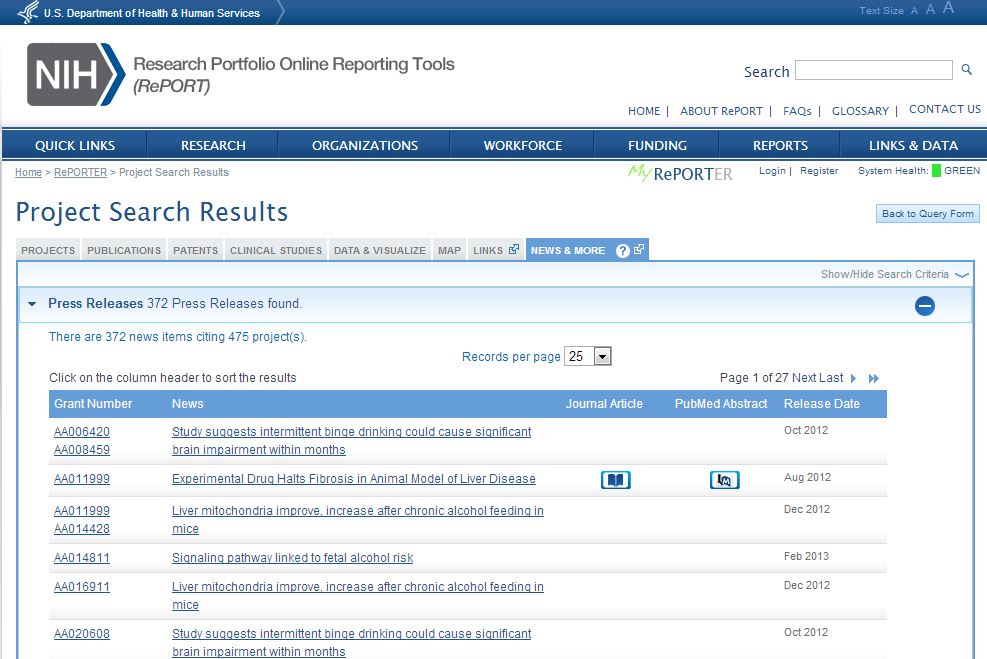
NIH requests that, prior to issuing a press release, public information officers get in touch with the funding NIH institute or center (IC) in advance, to allow for coordination.
Please visit the NIH media contacts directory or email [email protected] for help in identifying the appropriate NIH contact.
Universities using EurekAlert! or Newswise can include the NIH grant number when submitting releases, and this will automatically link your press release to the grant record in RePORTER, a comprehensive searchable public database of NIH grants.
Following a project search on REPORTER, users can then access press releases related to their search results in the "News & More" tab.
PIOs that do not use EurekAlert! or Newswise can contact NIH for help in linking their press release to grant records on RePORTER.