 An official website of the United States government


When Are Two Heads Better Than One? Considerations When Using the NIH Multiple Principal Investigator Model
Nearly two decades ago, we began allowing more than one researcher to be designated as program director/principal investigator (PD/PI) on a single grant award. The multiple PD/PI (MPI) model can provide important benefits, including giving each investigator credit as an NIH-designated PD/PI, but it is not required to conduct collaborative or team science. It is intended to supplement—not replace—the traditional single-PD/PI model. Here, we revisit when multiple PD/PIs may make sense, as well as some of the responsibilities and potential drawbacks investigators should consider.
Let’s start with the basics for MPI grants:
- More than one investigator is responsible for managing the research project.
- One MPI is designated as the Contact PI and is responsible for communicating with NIH.
- When the MPIs come from more than one institution, the contact PI’s institution is the prime applicant organization and becomes the recipient named in the Notice of Award if the grant is made.
- The recipient institution distributes the funds via domestic subawards to the other institutions and oversees the grant.
- The contact institution is responsible for the administrative arm of the project (e.g., submitting progress reports) while all PIs are responsible for managing the project scientifically
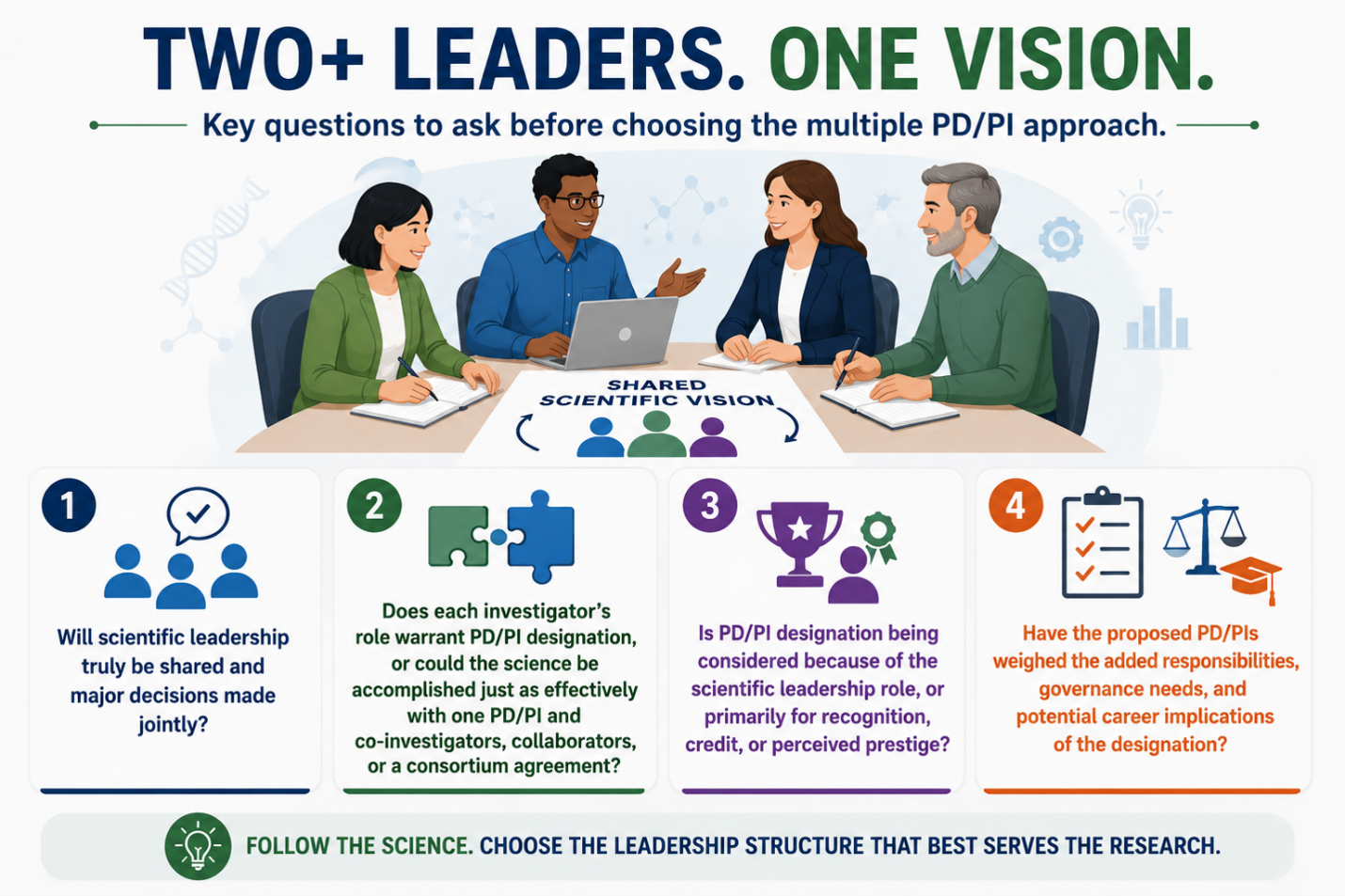
The MPI approach can work well when scientific leadership of a team science project is genuinely shared among two or more investigators. This means all named PIs hold equal scientific accountability to NIH for the success of the project. The PI roles and structure for managing decision-making within the team are explained in the application’s leadership plan. However, it is important to recognize that single PI grants can also support senior researchers in addition to the PI as co-investigators or consultants, including using consortium agreements when multiple institutions are involved.
Although MPI grants can have some advantages, there can also be drawbacks. For instance, early stage investigators (ESIs) should consider the potential effect on their ESI status. An MPI application receives ESI consideration only if all PD/PIs are eligible, and receiving certain substantial independent research awards as a PD/PI generally ends an investigator’s ESI status (see more below).
When rolling out the policy initially, we anticipated the number of multi-PD/PI projects to be relatively small compared to the traditional one PD/PI model. As this flexibility evolved for use on different grant types over time, the numbers grew. Tables 1-3 below (in the drop down menus) provide data on MPI applications and awards from fiscal years (FYs) 2008 to 2025. In brief:
- Nearly 6% of competing applications submitted to NIH in FY 2008 used the multiple PD/PI model, compared with more than 31% in FY 2025 (Table 1). The share of awards using the MPI model increased similarly, from about 4% to about 31%.
- In recent FYs, roughly three-quarters of MPI applications involved two PD/PIs, about one-fifth involved three, and only a small share involved four or more (Table 2). Although two-PD/PI teams remain by far the most common, MPI teams have become somewhat larger over time. During the earliest FYs of the policy, about 80% of MPI applications involved two PD/PIs, roughly 13%–14% involved three, and a relatively small share involved four or more.
- Single-PD/PI applications had slightly higher success rates in most of the earlier years, whereas the difference between the two became small (and inconsistent) between FYs 2015 through 2024 (Table 3). In FY 2025, the rates were again very similar—14.0% for MPI applications and 14.3% for single-PD/PI applications. Both were markedly lower than in recent years, due in part to NIH forward funding more grants. See also this FY 2025 By the Numbers post from March.
So, what should you keep in mind when considering the multi-PD/PI approach?
- Consider various grant types first. Collaborative team science can be conducted through other grant types specifically designed for cases where highly integrated, multidisciplinary teams are needed. In addition, R01s and other grants can support teamwork with or without the use of the MPI approach.
- Make sure the designation reflects the role. PD/PI is a leadership role, not an honorary designation. More PD/PIs do not make an application more competitive, and the designation should not simply recognize a collaborator or add perceived gravitas. Each PD/PI should have a substantive role in directing the science and genuinely intend to share the authority, responsibility, and accountability that come with the designation.
- Consider potential career-stage consequences. A multiple PD/PI application receives new investigator or ESI consideration only when all PD/PIs qualify. Because successfully competing as a PD/PI on a substantial independent research award generally ends new investigator or ESI status, early-career researchers should consider the implications before taking on the role.
- Remember that the recipient organization retains the ability to manage the funds from the award per NIH policies.
- Have a clear plan for shared leadership. The required Leadership Plan could be thought of as an operating agreement for the collaboration—and an opportunity to demonstrate how shared leadership will support the science. It should explain why the multiple PD/PI approach is appropriate, define each PD/PI's role and responsibilities, and describe how the team will make decisions, communicate, and resolve conflicts.
- Consider special requirements for international collaborations. If your proposed multiple PD/PI team includes investigators at foreign organizations, please Review the Collaborative International Research Project (PF5) grant type and applicable funding opportunity requirements when planning the collaboration. For instance, an application with multiple foreign collaborators at different institutions would submit an application with multiple International Project components. See also this NIH Guide Notice and this NIH Extramural nexus article.
- Do not expect a review advantage. Reviewers will consider each PD/PI’s qualifications and role, as well as consider how the Leadership Plan contributes to the project’s scientific and technical merit.
The key is choosing a leadership structure and grant type that best fits the science, not maximizing the number of names that appear as PD/PIs on an application. PD/PI designation should follow the scientific and leadership needs of the project—not precede them. When shared scientific leadership is truly necessary, clearly defined, and thoughtfully planned, the multiple PD/PI model can be an effective way to bring complementary expertise together under a single NIH award, but it is not the only way to support productive collaborations or team science.
Additional Resources
- NIH Grants Policy Statement: Multiple Program Director/Principal Investigator Applications and Awards
- FAQs: Multiple PD/PIs
- National Institute of General Medical Sciences: Considerations for Multiple Principal Investigator (MPI) Applications
- National Academies of Sciences, Engineering, and Medicine: Introduction - The Science and Practice of Team Science
Additional Notes Related to the Data:
- These data Represent only application and award information for programs that allow multiple PD/PIs. Fellowships, construction programs, shared instrumentation, and other grant types that do not permit multiple PD/PIs were excluded from the analysis.
- Because MPI status was identified using an administrative MPI indicator, some counts in Table 2 may not sum precisely to the reported totals. These small differences do not affect the overall trends.
- Success rates (discussed in Table 3) are calculated by dividing the number of distinct awarded applications by the number of distinct applications submitted in a particular fiscal year.
- Here we refer to investigators receiving awards for simplicity, but recognize that NIH makes awards to institutions (not individual researchers).
- These data include analyses of awards made with direct budget authority and COVID-19 supplemental appropriations, but exclude American Recovery and Reinvestment Act funds.
FY | Application Count All | Award Count All | Application Count MPI | Award Count MPI | MPI Application Percent | MPI Award Percent |
| 2025 | 75,119 | 10,657 | 23,563 | 3,289 | 31.4 | 30.9 |
| 2024 | 66,422 | 13,050 | 20,513 | 4,140 | 30.9 | 31.7 |
| 2023 | 61,980 | 14,075 | 18,651 | 4,347 | 30.1 | 30.9 |
| 2022 | 64,545 | 14,210 | 19,256 | 4,321 | 29.8 | 30.4 |
| 2021 | 70,348 | 14,084 | 19,884 | 4,018 | 28.3 | 28.5 |
| 2020 | 65,599 | 14,363 | 17,298 | 3,915 | 26.4 | 27.3 |
| 2019 | 64,587 | 14,186 | 16,337 | 3,604 | 25.3 | 25.4 |
| 2018 | 64,508 | 14,099 | 15,449 | 3,471 | 23.9 | 24.6 |
| 2017 | 64,480 | 13,099 | 14,967 | 2,962 | 23.2 | 22.6 |
| 2016 | 65,350 | 13,226 | 14,012 | 2,848 | 21.4 | 21.5 |
| 2015 | 61,452 | 12,184 | 12,214 | 2,454 | 19.9 | 20.1 |
| 2014 | 60,336 | 12,121 | 10,995 | 2,150 | 18.2 | 17.7 |
| 2013 | 59,100 | 10,796 | 9,736 | 1,720 | 16.5 | 15.9 |
| 2012 | 61,244 | 11,900 | 9,596 | 1,717 | 15.7 | 14.4 |
| 2011 | 60,182 | 11,458 | 8,578 | 1,522 | 14.3 | 13.3 |
| 2010 | 57,506 | 12,319 | 6,259 | 1,284 | 10.9 | 10.4 |
| 2009 | 51,583 | 11,901 | 4,625 | 911 | 9 | 7.7 |
| 2008 | 51,134 | 12,639 | 2,873 | 557 | 5.6 | 4.4 |
FY | Person Group Collapsed | Application Count MPI Group | Application Count MPI | MPI Application Percent |
|---|---|---|---|---|
| 2025 | 2 | 17,661 | 23,563 | 75 |
| 2025 | 3 | 4,735 | 23,563 | 20.1 |
| 2025 | 4 | 843 | 23,563 | 3.6 |
| 2025 | 5 | 199 | 23,563 | 0.8 |
| 2025 | 6 + | 122 | 23,563 | 0.5 |
| 2024 | 2 | 15,303 | 20,513 | 74.6 |
| 2024 | 3 | 4,173 | 20,513 | 20.3 |
| 2024 | 4 | 755 | 20,513 | 3.7 |
| 2024 | 5 | 186 | 20,513 | 0.9 |
| 2024 | 6 + | 95 | 20,513 | 0.5 |
| 2023 | 2 | 14,189 | 18,651 | 76.1 |
| 2023 | 3 | 3,615 | 18,651 | 19.4 |
| 2023 | 4 | 619 | 18,651 | 3.3 |
| 2023 | 5 | 143 | 18,651 | 0.8 |
| 2023 | 6 + | 85 | 18,651 | 0.5 |
| 2022 | 2 | 14,724 | 19,256 | 76.5 |
| 2022 | 3 | 3,636 | 19,256 | 18.9 |
| 2022 | 4 | 643 | 19,256 | 3.3 |
| 2022 | 5 | 143 | 19,256 | 0.7 |
| 2022 | 6 + | 110 | 19,256 | 0.6 |
| 2021 | 2 | 15,297 | 19,884 | 76.9 |
| 2021 | 3 | 3,632 | 19,884 | 18.3 |
| 2021 | 4 | 673 | 19,884 | 3.4 |
| 2021 | 5 | 171 | 19,884 | 0.9 |
| 2021 | 6 + | 109 | 19,884 | 0.5 |
| 2020 | 2 | 13,691 | 17,298 | 79.1 |
| 2020 | 3 | 2,886 | 17,298 | 16.7 |
| 2020 | 4 | 529 | 17,298 | 3.1 |
| 2020 | 5 | 116 | 17,298 | 0.7 |
| 2020 | 6 + | 72 | 17,298 | 0.4 |
| 2019 | 2 | 12,975 | 16,337 | 79.4 |
| 2019 | 3 | 2,696 | 16,337 | 16.5 |
| 2019 | 4 | 494 | 16,337 | 3 |
| 2019 | 5 | 113 | 16,337 | 0.7 |
| 2019 | 6 + | 58 | 16,337 | 0.4 |
| 2018 | 2 | 12,491 | 15,449 | 80.9 |
| 2018 | 3 | 2,365 | 15,449 | 15.3 |
| 2018 | 4 | 443 | 15,449 | 2.9 |
| 2018 | 5 | 76 | 15,449 | 0.5 |
| 2018 | 6 + | 72 | 15,449 | 0.5 |
| 2017 | 2 | 11,918 | 14,967 | 79.6 |
| 2017 | 3 | 2,423 | 14,967 | 16.2 |
| 2017 | 4 | 455 | 14,967 | 3 |
| 2017 | 5 | 93 | 14,967 | 0.6 |
| 2017 | 6 + | 76 | 14,967 | 0.5 |
| 2016 | 2 | 11,391 | 14,012 | 81.3 |
| 2016 | 3 | 2,060 | 14,012 | 14.7 |
| 2016 | 4 | 392 | 14,012 | 2.8 |
| 2016 | 5 | 92 | 14,012 | 0.7 |
| 2016 | 6 + | 70 | 14,012 | 0.5 |
| 2015 | 2 | 9,934 | 12,214 | 81.3 |
| 2015 | 3 | 1,767 | 12,214 | 14.5 |
| 2015 | 4 | 375 | 12,214 | 3.1 |
| 2015 | 5 | 80 | 12,214 | 0.7 |
| 2015 | 6 + | 50 | 12,214 | 0.4 |
| 2014 | 2 | 8,878 | 10,995 | 80.7 |
| 2014 | 3 | 1,591 | 10,995 | 14.5 |
| 2014 | 4 | 336 | 10,995 | 3.1 |
| 2014 | 5 | 108 | 10,995 | 1 |
| 2014 | 6 + | 72 | 10,995 | 0.7 |
| 2013 | 2 | 7,947 | 9,736 | 81.6 |
| 2013 | 3 | 1,364 | 9,736 | 14 |
| 2013 | 4 | 307 | 9,736 | 3.2 |
| 2013 | 5 | 68 | 9,736 | 0.7 |
| 2013 | 6 + | 50 | 9,736 | 0.5 |
| 2012 | 2 | 7,787 | 9,596 | 81.1 |
| 2012 | 3 | 1,365 | 9,596 | 14.2 |
| 2012 | 4 | 316 | 9,596 | 3.3 |
| 2012 | 5 | 90 | 9,596 | 0.9 |
| 2012 | 6 + | 38 | 9,596 | 0.4 |
| 2011 | 2 | 6,958 | 8,578 | 81.1 |
| 2011 | 3 | 1,190 | 8,578 | 13.9 |
| 2011 | 4 | 284 | 8,578 | 3.3 |
| 2011 | 5 | 89 | 8,578 | 1 |
| 2011 | 6 + | 57 | 8,578 | 0.7 |
| 2010 | 2 | 5,066 | 6,259 | 80.9 |
| 2010 | 3 | 860 | 6,259 | 13.7 |
| 2010 | 4 | 201 | 6,259 | 3.2 |
| 2010 | 5 | 73 | 6,259 | 1.2 |
| 2010 | 6 + | 59 | 6,259 | 0.9 |
| 2009 | 2 | 3,734 | 4,625 | 80.7 |
| 2009 | 3 | 644 | 4,625 | 13.9 |
| 2009 | 4 | 160 | 4,625 | 3.5 |
| 2009 | 5 | 42 | 4,625 | 0.9 |
| 2009 | 6 + | 45 | 4,625 | 1 |
| 2008 | 2 | 2,380 | 2,873 | 82.8 |
| 2008 | 3 | 363 | 2,873 | 12.6 |
| 2008 | 4 | 89 | 2,873 | 3.1 |
| 2008 | 5 | 17 | 2,873 | 0.6 |
| 2008 | 6 + | 24 | 2,873 | 0.8 |
FY | Application Count Single PD/PI | Award Count Single PD/PI | Success Rate Single PD/PI | Application Count MPI | Award Count MPI | Success Rate MPI |
| 2025 | 51,556 | 7,368 | 14.3 | 23,563 | 3,289 | 14 |
| 2024 | 45,909 | 8,910 | 19.4 | 20,513 | 4,140 | 20.2 |
| 2023 | 43,329 | 9,728 | 22.5 | 18,651 | 4,347 | 23.3 |
| 2022 | 45,289 | 9,889 | 21.8 | 19,256 | 4,321 | 22.4 |
| 2021 | 50,464 | 10,066 | 19.9 | 19,884 | 4,018 | 20.2 |
| 2020 | 48,301 | 10,448 | 21.6 | 17,298 | 3,915 | 22.6 |
| 2019 | 48,250 | 10,582 | 21.9 | 16,337 | 3,604 | 22.1 |
| 2018 | 49,059 | 10,628 | 21.7 | 15,449 | 3,471 | 22.5 |
| 2017 | 49,513 | 10,137 | 20.5 | 14,967 | 2,962 | 19.8 |
| 2016 | 51,338 | 10,378 | 20.2 | 14,012 | 2,848 | 20.3 |
| 2015 | 49,238 | 9,730 | 19.8 | 12,214 | 2,454 | 20.1 |
| 2014 | 49,341 | 9,971 | 20.2 | 10,995 | 2,150 | 19.6 |
| 2013 | 49,364 | 9,076 | 18.4 | 9,736 | 1,720 | 17.7 |
| 2012 | 51,648 | 10,183 | 19.7 | 9,596 | 1,717 | 17.9 |
| 2011 | 51,604 | 9,936 | 19.3 | 8,578 | 1,522 | 17.7 |
| 2010 | 51,247 | 11,035 | 21.5 | 6,259 | 1,284 | 20.5 |
| 2009 | 46,958 | 10,990 | 23.4 | 4,625 | 911 | 19.7 |
| 2008 | 48,261 | 12,082 | 25 | 2,873 | 557 | 19.4 |