 An official website of the United States government


Driving Innovation through Challenges and Prize Competitions
NIH continues to expand its use of challenges and prize competitions as part of its strategy to foster innovation and solve complex biomedical and public health problems. Through this approach, NIH engages a wider range of innovators, encourages creative approaches, rewards novel ideas and proven solutions, and accelerates progress toward improving human health.
What Are Challenges and Prize Competitions?
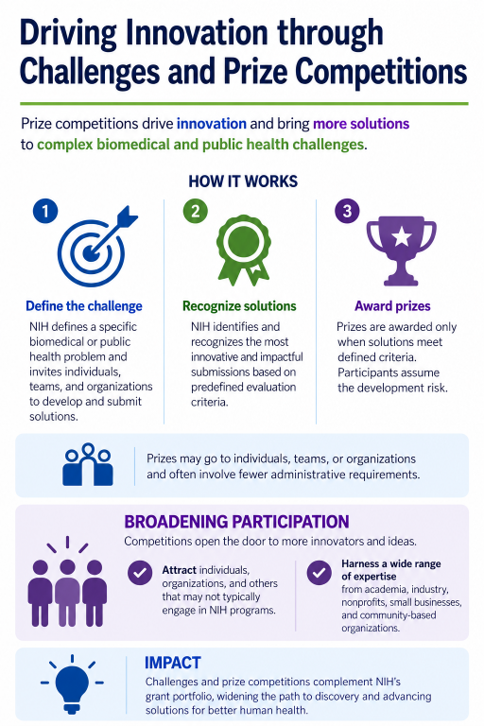
Challenges and Prize Competitions are an effective tool within the NIH toolbox to catalyze biomedical innovation and complement traditional funding mechanisms of grants, contracts, and cooperative agreements. They enable NIH Institutes, Centers, and Offices (ICOs) to establish ambitious goals while limiting risk, by paying only for successful results. This approach allows NIH to reward outcomes while encouraging creative approaches to solving particular problems. It also affords NIH the opportunity to engage innovators across the country who have a wide range of skills and expertise, including individuals who may not typically participate in NIH research activities.
Through this mechanism, NIH defines a specific problem and invites participants to develop and submit solutions and rewards the most successful submissions with cash prizes and/or public recognition. Prizes may be awarded to eligible individuals, teams, or organizations, depending on the eligibility and participation rules of each challenge.
Because challenges generally have a smaller set of requirements than grants, contracts, and cooperative agreements, they may lower the threshold for participation and attract students, educators, corporations, and nonprofit and community-based organizations. Prize terms and conditions vary by competition, and recipients generally have flexibility in the use of prize funds, subject to applicable challenge rules.
NIH has increasingly applied this open innovation mechanism to solve a wide range of scientific and public health problems. Previous challenges and prize competitions have sought:
- Novel diagnostic devices
- Drug delivery platforms
- Digital technologies for health promotion
- Algorithms and code for data analysis
- Curricula for improving education and awareness of a health topic
- Business plans for new health startups
In fiscal year 2026, NIH launched or co-sponsored a record 32 challenges and prize competitions offering over $62 million in prizes. NIH continues to explore new ways to leverage this open innovation and crowdsourcing mechanism to advance the agency’s mission.
When a Challenge May Not Be the Right Approach
NIH continues to rely on supporting research through grants when:
- Research requires sustained, exploratory investigation, especially when the scientific path, methods, or outcomes cannot be clearly defined in advance and knowledge develops over time
- Success cannot be measured against clearly defined criteria
- Upfront resources are needed to conduct the research, such as funding for support personnel, infrastructure, equipment, or other substantial research costs before results can be produced
In summary, challenges and prize competitions are intended to complement NIH’s grant-making portfolio, not replace it. These competitions can help accelerate the path to discovery and encourage innovative solutions to clearly defined health challenges. NIH will continue to use challenges and prize competitions where appropriate, to advance biomedical discovery and improve human health.
Learn more about active challenges on the NIH Challenges & Prize Competitions webpage.