 An official website of the United States government


Introducing Highlighted Topics: A Centralized and Simple Resource to Learn About Research Areas of Interest to NIH
We are excited to announce a new centralized and simplified resource, called NIH Highlighted Topics, that informs the research community about particular areas of science of interest to NIH. Visiting this resource early and often when conceptualizing your research ideas will help ensure you are aware of some of NIH’s latest scientific interests. It also aims to help facilitate innovation and discovery through a strong focus on more investigator initiated driven research.
Our Highlighted Topics resource represents scientific areas where NIH encourages applications from the community. These topics target areas within the NIH mission, including areas that may not be readily associated with the particular funding Institute or Center or may even be a new or emerging area that is not well known. Please understand that these are simply topical area descriptions, not funding opportunities.
The Bigger Picture
This consolidated resource is integrated into a wider ongoing strategy across NIH to simplify and streamline the application and funding process. these efforts continue our long-standing direction to reduce the time, effort, complexity, and possible confusion researchers may experience when seeking funding, and also reduce duplication across federal systems. As part of this wider strategy, we will focus on investigator-initiated research through parent announcements while reducing the amount of unique and highly specific funding opportunities.
New targeted funding opportunities will only be posted in Grants.gov, a federal-wide portal for discretionary funding opportunities, starting on October 1, 2025 (NOT-OD-25-143). The NIH Guide for Grants and Contracts will continue to be used for policy and informational notices, but will not include funding opportunities. Because we recognize the NIH Guide's value to the research community, we are envisioning how to utilize the Guide together with the new Highlighted Topics resource to continue helping researchers navigate the application process and gain insight into our research interests.
What You Will Experience with the Highlighted Topics
You can find this new Highlighted Topics resource through our Find a Fit for Your Research page, which helps the research community better understand the NIH structure when seeking funding. The topics are presented in a simple, tabular format to easily explore. Now, researchers can start here to learn about timely areas of science NIH is interested in, instead of needing to visit various NIH institute, center, office, or program-specific webpages to find this information.
Users can search for topics and filter by particular Institutes, Centers, or Offices. Additional topics will be added to this initial list on a regular basis, so check back often.
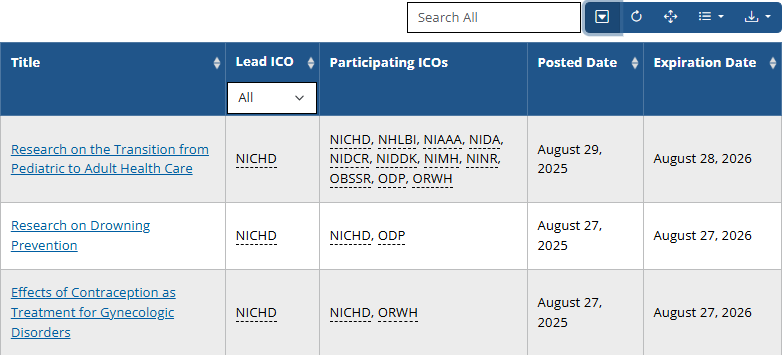
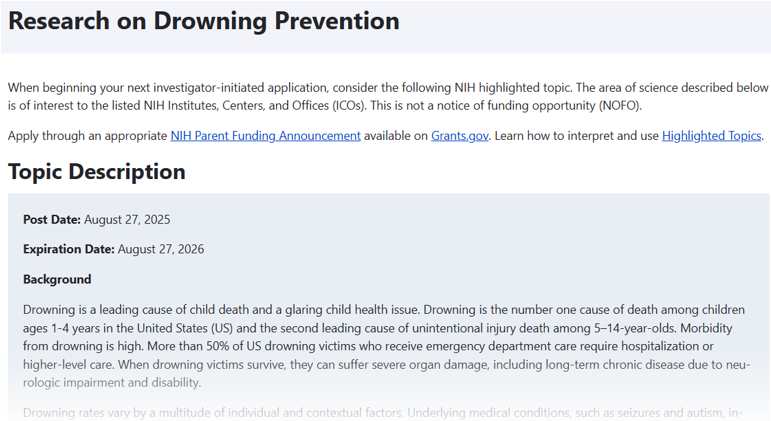
Clicking on a particular topic (e.g., Research on Drowning Prevention) will reveal additional insights into the area of science, descriptions from participating NIH Institutes, Centers, and Offices, when the topic will expire, and scientific contacts to ask questions.
What to Do If Interested in a Particular Topic?
If a particular topic is of interest, researchers must develop an investigator-initiated application through one of our Parent Announcements or other broad NIH funding opportunities available on Grants.gov. Once submitted, the application will undergo our rigorous and thorough peer review process to assess its scientific and technical merit.
In some cases, an NIH Institute or Center may also dedicate funding to particular Topics within their mission. In those situations, the amount of funding actually awarded in the topic area will depend on the availability of funds, the number of meritorious applications, and competing priorities. Institutes and Centers, at their discretion, may also prioritize funding applications that respond to particular topic areas.
We welcome you to explore the available Highlighted Topics today. Check back regularly as new topics are added in the coming months and beyond. We also plan related resources and digital enhancements to ensure it remains a useful tool for the research community. You can also provide input at the email below.